A check-engine light can turn a normal commute into a guessing game. This OBD2 scanner guide cuts through the jargon so you can identify what your vehicle is reporting, decide whether a fix is realistic at home, and shop for a scanner that earns its space in the glove box.
For everyday drivers, the right scanner can save a diagnostic fee, confirm whether a loose gas cap may be the issue, and give you better information before calling a repair shop. For BMW, Audi, Mercedes-Benz, Porsche, Tesla, Lexus, and Land Rover owners, the right tool may also reveal brand-specific systems that a basic code reader cannot see. The key is buying for the job you actually need, not for the longest feature list.
What an OBD2 Scanner Actually Does
OBD2 means On-Board Diagnostics, Generation 2. Most gasoline vehicles sold in the United States from model year 1996 onward use the standard 16-pin OBD2 port, usually located beneath the driver-side dashboard. Plugging in a compatible scanner lets it communicate with the vehicle’s computer and retrieve diagnostic trouble codes.
A code is a starting point, not a final repair instruction. For example, a code related to an oxygen sensor might point to the sensor itself, but it can also be caused by damaged wiring, an exhaust leak, or an air-fuel issue elsewhere. A quality scanner helps you see the code, its description, and sometimes live sensor data. It does not replace diagnosis, mechanical inspection, or common sense.
Basic OBD2 readers generally handle engine and emissions-related codes. More advanced scan tools may access ABS, airbag, transmission, battery, steering, climate, and service systems. Those extras are valuable when they match your vehicle and your plans. They are wasted money if you only want to understand an occasional check-engine light.
OBD2 Scanner Guide: Pick the Right Type
The quickest way to narrow the field is to decide how you want to use the scanner. There are three practical categories, each with a different balance of price, convenience, and capability.
Bluetooth dongles for phone-first drivers
A Bluetooth OBD2 adapter plugs into the diagnostic port and pairs with an app on your iPhone or Android phone. It is compact, easy to store, and often the best value for drivers who are comfortable using apps. Depending on the adapter and app, you may read and clear codes, view live gauges, run emissions readiness checks, and log driving data.
The trade-off is that app quality matters as much as the adapter. Some features may require a paid app subscription or one-time purchase. Check whether the adapter supports iOS or Android, whether it uses Bluetooth or Wi-Fi, and whether the app offers enhanced coverage for your make and model. Cheap no-name adapters can be tempting during a limited-time offer, but unstable connections and vague compatibility claims create more frustration than savings.
Handheld code readers for simple, no-phone checks
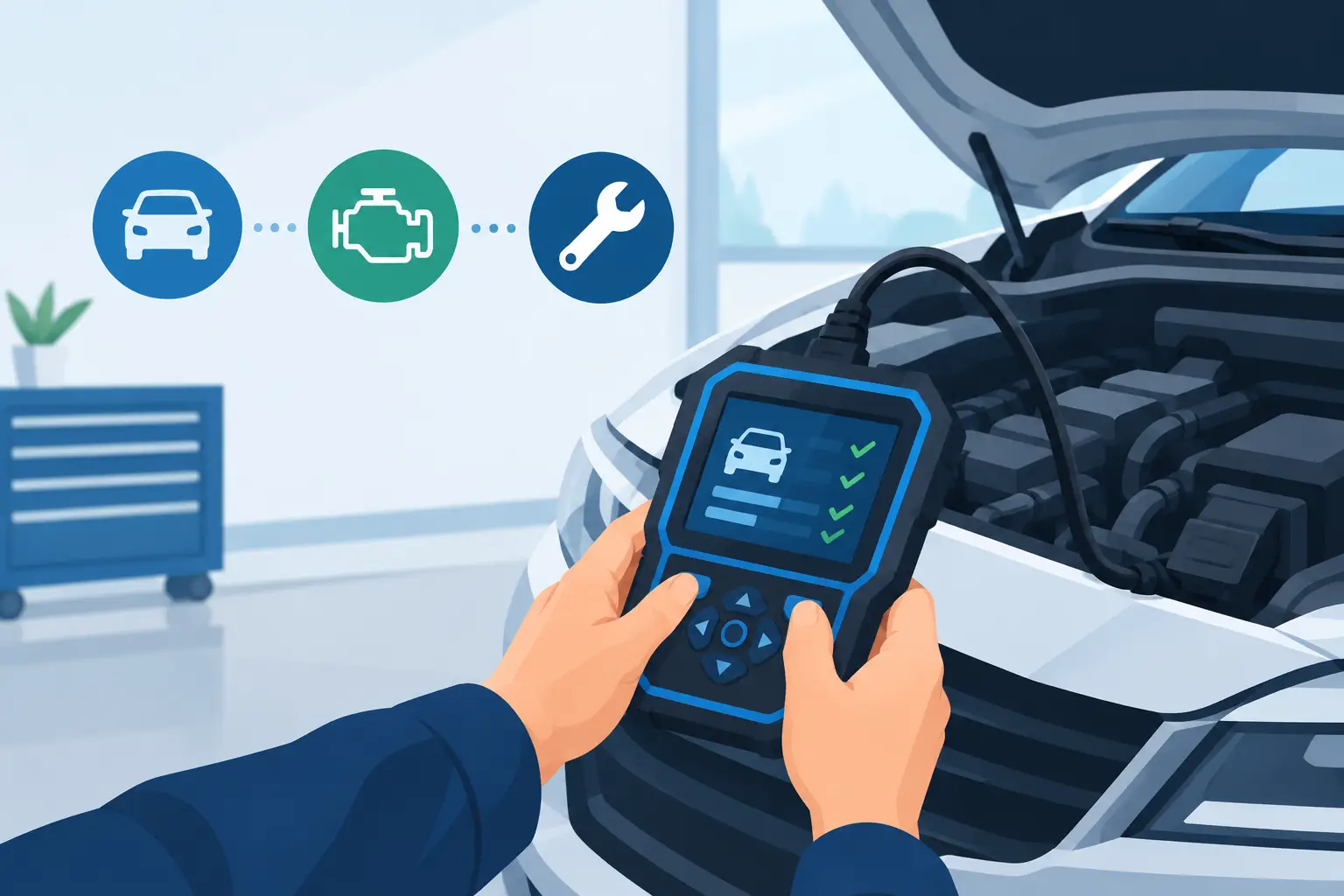
A handheld scanner has its own screen, buttons, and cable. This is a smart choice if you want a straightforward tool that is ready whenever a warning light appears. There is no pairing process, drained phone battery, or app permission to manage.
Look for a clear display, plain-language code definitions, an easy-to-reach cable length, and the ability to show freeze-frame data. Freeze-frame data captures key operating conditions when the fault occurred, such as engine temperature, speed, and RPM. It can help explain whether a problem happened at startup, under load, or during a hot idle.
A basic handheld reader is especially useful for older daily drivers, family vehicles, and anyone who wants fast answers before visiting a parts store or repair shop. It will not usually provide the dealer-level access needed for electronic parking brakes, battery registration, or module coding.
Advanced scan tools for enthusiasts and repeat repairs
Advanced scanners cost more because they go beyond generic engine codes. They may read manufacturer-specific modules, perform active tests, display deeper live data, reset maintenance indicators, calibrate certain components, or support service functions. Some professional-style tools also provide guided diagnostics and vehicle coverage updates.
This category makes sense for a hands-on enthusiast maintaining several vehicles, a classic-car owner adding modern diagnostic capability, or a driver who routinely handles brakes, batteries, and suspension work. It is also the better option when you own a European luxury vehicle with many electronic systems.
Do not assume “advanced” means universal. A scanner might support an oil reset for one BMW generation but not a battery registration for another. Before buying, verify exact year, model, engine, trim, and function. Compatibility is a purchase criterion, not a small-print detail.
Check Compatibility Before You Shop
Start with the vehicle, not the scanner. Confirm your model year and identify whether you need generic OBD2 diagnostics or enhanced access to manufacturer modules. Nearly every 1996-and-newer passenger vehicle in the US has an OBD2 port, but feature availability varies widely.
If you drive a hybrid, plug-in hybrid, EV, diesel truck, or a vehicle with advanced driver-assistance features, read the scanner’s supported-system details carefully. A generic reader may communicate with standard powertrain data while leaving battery-management, charging, chassis, or body-control information unavailable.
Also consider physical fit. Most adapters fit under the dash without trouble, but a bulky dongle can be exposed near your knees or interfere with a panel on certain vehicles. If you plan to leave a Bluetooth adapter connected, choose a low-profile model and check whether it has an automatic sleep mode. A poorly designed adapter can slowly draw power when a vehicle sits for extended periods.
Features Worth Paying For
The best deal is not always the lowest sticker price. A few functions offer real day-to-day value and can make a modest upgrade worthwhile.
Live data is one of the most useful features. It lets you watch readings such as coolant temperature, fuel trims, battery voltage, engine RPM, and oxygen-sensor activity. You do not need to become a technician to benefit from it. Watching battery voltage before winter or confirming that an engine reaches normal operating temperature can reveal useful clues.
Emissions readiness monitors are another practical feature. If your state requires emissions testing, readiness status tells you whether the vehicle has completed its self-checks. This matters after a repair, battery disconnect, or code clearing. Clearing a code immediately before an inspection may turn off the check-engine light, but it can also reset monitors and cause a failed or incomplete test.
For enthusiasts, look for brand-specific diagnostics, service resets, and active tests. An active test lets the scanner command a component, such as a cooling fan or fuel pump relay, when supported. These functions can save time, but they should be used carefully. Never run a test unless you understand what the component does and the area around it is safe.
How to Read Codes Without Chasing Parts
Connect the scanner with the ignition in the position specified by its instructions. Many vehicles require the ignition on with the engine off for an initial scan; others can be scanned while running for live data. Record all stored, pending, and permanent codes before clearing anything.
Stored codes indicate a fault the computer has confirmed. Pending codes mean a condition has been noticed but may need another drive cycle before it becomes a confirmed warning. Permanent codes generally remain until the vehicle verifies that the repair worked. These distinctions help you avoid replacing parts based on one temporary event.
Write down the code number, its description, freeze-frame information, and any symptoms you notice. Is the engine rough at idle? Did the warning appear after refueling? Is there a hard start, reduced power message, or drop in fuel economy? The code plus the symptom is far more useful than the code alone.
Avoid clearing codes just to make the light disappear. If the issue remains, the light will return. Clearing also erases diagnostic evidence and can reset emissions monitors. Clear a code after documenting it and making a repair, then rescan after a normal drive cycle to see whether the fault returns.
When a Scanner Is Not Enough
An OBD2 scanner cannot inspect worn brake pads, find a tire leak, measure paint damage, or diagnose every noise from a suspension. It also cannot guarantee that a suggested repair is correct. Treat it as a fast information tool, not a replacement for a qualified technician when safety systems, fuel leaks, overheating, braking, or airbag faults are involved.
If the check-engine light is flashing, reduce driving and address it promptly. A flashing light often signals an active misfire that can damage the catalytic converter. Stop driving if you see an oil-pressure warning, severe overheating, smoke, a strong fuel smell, or major loss of braking performance.
A scanner is most valuable when it turns uncertainty into a better next step. Choose a simple reader for quick check-engine answers, a Bluetooth setup for convenient app-based monitoring, or an enhanced tool when your vehicle and repair plans justify the added access. Buy for your car, keep the code history, and you will spend less time guessing when the next warning light appears.