A dead battery can turn an easy commute, weekend trail ride, or quick errand into a long walk home. The right electric bike charger is not just a replacement accessory – it protects a costly battery, keeps your e-bike ready to ride, and saves you from buying a charger that simply will not fit.
For most riders, the best choice is the original charger supplied with the bike. If you need a spare, travel charger, or replacement, the details matter more than the sale price. Voltage, connector type, charging current, battery chemistry, and safety certifications should all match your e-bike’s requirements.
Start With Your Battery, Not the Charger
An e-bike charger must be compatible with the battery pack, not merely the bike brand or the shape of the charging port. Look at the label on your existing charger and battery before comparing any replacement. The key specifications are usually printed near the output rating.
The most important number is output voltage. A typical 36V e-bike battery uses a charger with a 42V output. A 48V battery commonly requires a 54.6V charger, while many 52V batteries use a 58.8V charger. These numbers are not interchangeable. Connecting a higher-voltage charger to the wrong battery can cause serious battery damage and create a fire risk.
Battery chemistry matters, too. Most modern e-bikes use lithium-ion batteries, but lithium battery systems can have different battery-management settings and charging requirements. A charger designed for lead-acid batteries is not an acceptable substitute for a lithium-ion e-bike charger, even when the voltage appears close.
If your old charger is available, matching its input and output information is the fastest route to a confident purchase. When the old charger is missing, check the battery label and the owner’s manual. If anything is unclear, contact the e-bike manufacturer before ordering.
Match the Electric Bike Charger Connector
A correct voltage is only half the job. Your electric bike charger also needs the correct connector, correct polarity, and a secure physical fit.
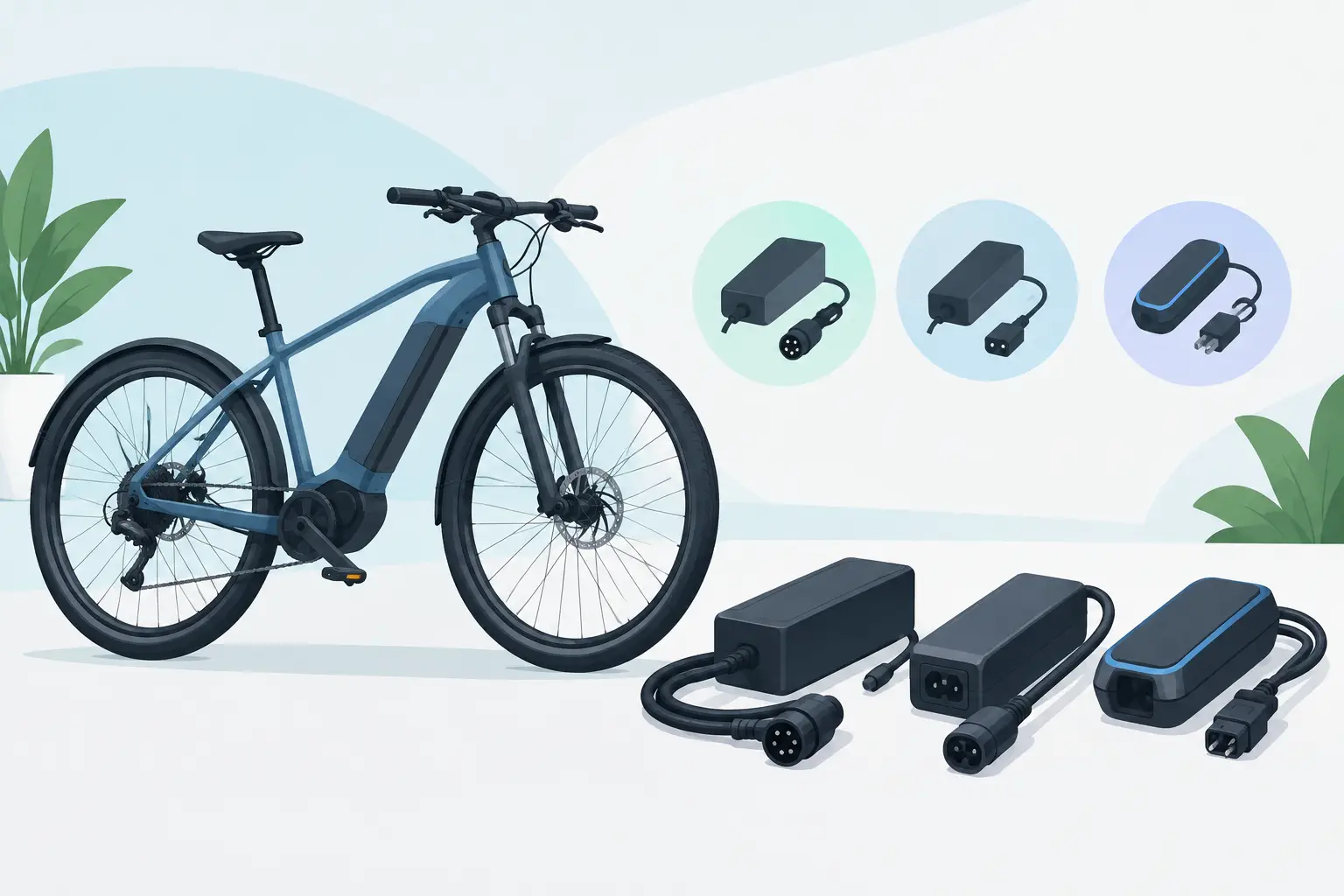
Common e-bike charging connectors include barrel plugs, three-pin XLR-style connectors, RCA-style plugs, GX aviation connectors, magnetic connectors, and brand-specific proprietary ports. Two plugs can look nearly identical in product photos but differ in pin layout, diameter, or polarity. Forcing a plug into a port is a quick way to damage the charging socket.
Before you buy, compare these details:
- The connector style and number of pins
- Plug diameter and shape, if using a barrel connector
- Positive and negative polarity markings
- Whether the charger connects directly to the battery or through the bike frame
Photos help, but measurements and model compatibility are better. A listing that names the exact e-bike model, battery voltage, and connector type gives you much more confidence than one labeled only as a “universal e-bike charger.” Universal is often a marketing shortcut, not a guarantee of safe compatibility.
Charging Amps Affect Speed and Battery Life
After voltage and connector fit, look at charging current, measured in amps. A higher-amp charger can reduce charging time, but it is not automatically the better deal.
A 2A charger is common for everyday e-bikes and tends to be gentle on the battery. A 3A or 4A charger may be useful for riders with larger batteries, long commutes, delivery routes, or frequent weekend rides. Faster charging is convenient, especially when your bike is transportation rather than recreation, but only use a higher-current charger if the battery manufacturer allows it.
More charging speed creates more heat. Heat is one of the biggest enemies of lithium-ion battery life, particularly in a garage during summer or inside a parked vehicle. A rider who charges overnight and has time to spare may get better long-term value from a standard charger than from the fastest option available.
A practical setup for frequent riders is often a standard charger at home and a compatible second charger at work, in an RV, or at a regular destination. That gives you flexibility without relying on aggressive fast charging every day.
Choose Safety Features Worth Paying For
Cheap chargers can be tempting when your original unit fails, but this is an accessory where a few dollars saved can become an expensive problem. Look for a charger with clear electrical specifications, solid housing, strain relief where the cable meets the brick and plug, and a visible charge-status indicator.
Useful protections include over-voltage protection, over-current protection, short-circuit protection, reverse-polarity protection, and over-temperature protection. A charger should also stop or taper charging when the battery reaches full capacity. Many quality units use a red light while charging and a green light when the battery is full, although indicator colors vary by manufacturer.
For US buyers, a recognized safety certification is a valuable signal. Check product documentation closely rather than trusting vague language such as “certified safe.” If a listing has missing output details, contradictory specifications, a flimsy connector, or reviews mentioning overheating, move on. Limited Time Offers are great when the product fits, but battery safety should never be a clearance-bin gamble.
OEM vs. Aftermarket Chargers
An original equipment manufacturer charger is usually the simplest and safest option. It is built for your battery system, requires less compatibility research, and may be necessary to preserve warranty coverage. The trade-off is price. OEM replacements can cost more, and certain brands may have limited availability.
A quality aftermarket electric bike charger can be a smart value choice when it precisely matches the voltage, connector, polarity, and recommended charging current. It can also be easier to find in compact travel versions or with a longer power cord. However, the buyer has more responsibility to verify every specification.
For premium commuter, cargo, and performance e-bikes, OEM is often worth the extra cost. For an older bike with a clearly labeled common battery system, a well-reviewed compatible replacement may make better financial sense. The decision depends on what you know about the battery and how much risk you are willing to accept.
Smart Chargers and Adjustable Chargers
Smart chargers add convenience, but they are not necessary for every rider. Some models offer selectable current settings, cooling fans, display screens, storage-charge modes, or automatic shutoff. A storage mode can be particularly useful if you put the bike away for several weeks, since lithium-ion batteries generally prefer being stored partially charged rather than sitting at 100% for long periods.
Adjustable chargers require extra care. The settings must match the battery’s approved limits every time you use them. They are best for informed riders who understand their battery specifications, not for anyone who wants a plug-in-and-forget solution.
A basic compatible charger with dependable protection is usually the better everyday buy than a feature-heavy unit with confusing settings. Shop the specifications first, then compare price, current discounts, and included warranty support.
Charge Your E-Bike Safely at Home
Even the best charger needs smart habits. Charge your battery on a hard, dry, nonflammable surface with room for air circulation. Keep it away from direct sunlight, heaters, fuel, solvents, cardboard boxes, and cluttered workbenches. Do not cover the charger or battery while charging.
Let a battery cool down after a hard ride before connecting it. Likewise, avoid charging a battery that has been sitting in freezing conditions until it has warmed to the temperature range recommended by its manufacturer. Cold-weather charging can permanently damage lithium-ion cells.
Avoid extension cords when possible. If you must use one, choose a heavy-duty cord in good condition and do not overload the outlet. Never charge a battery with a swollen case, cracked housing, damaged port, frayed charger cable, burning smell, or unusual heat. Stop using the equipment and seek manufacturer guidance.
It is also wise to stay nearby while charging, especially with a new charger or a battery that has been stored for months. Overnight charging may be convenient, but unattended charging removes your ability to react quickly if something is wrong.
When a Charger Is Not the Problem
A charger that shows a green light immediately may be fully charging a battery – or it may be signaling that the battery is not accepting power. Before replacing it, inspect the wall outlet, cable, connectors, fuse, and battery contacts. Dirt, bent pins, moisture, and a loose port can all interrupt charging.
If you have access to a multimeter and know how to use one safely, it can help confirm whether the charger is producing its rated output. Otherwise, a local e-bike shop can test the charger and battery system. This is often cheaper than ordering multiple replacement parts and hoping one solves the issue.
The right electric bike charger should make ownership easier, not add uncertainty. Match the battery specifications exactly, prioritize proven safety features, and choose charging speed that fits your routine. A well-chosen spare charger is one of those practical upgrades that earns its place every time your next ride is ready when you are.